
Author: Jhilmil Rathore (Student Volunteer) | 3rd January, 2026

A terrace is one of the most open spaces in an Indian home, yet it ends up holding the most. It absorbs what the house cannot—truths that don’t fit inside small rooms, emotions that feel too loud for shared walls, and parts of ourselves that have nowhere else to exist. In households where privacy is almost non-existent—doors rarely locked, walls that carry sound, rooms shared—the terrace becomes the only place where the self can stretch without interruption.
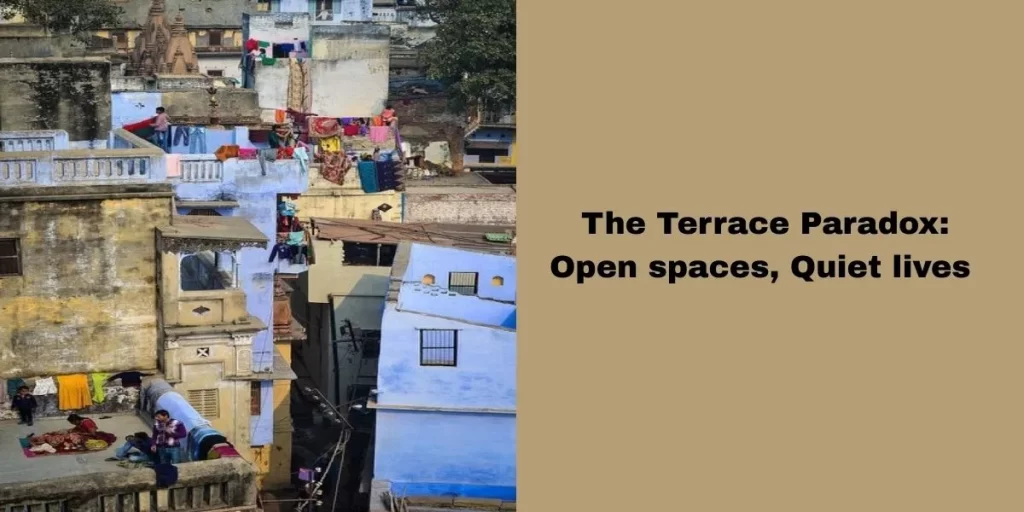
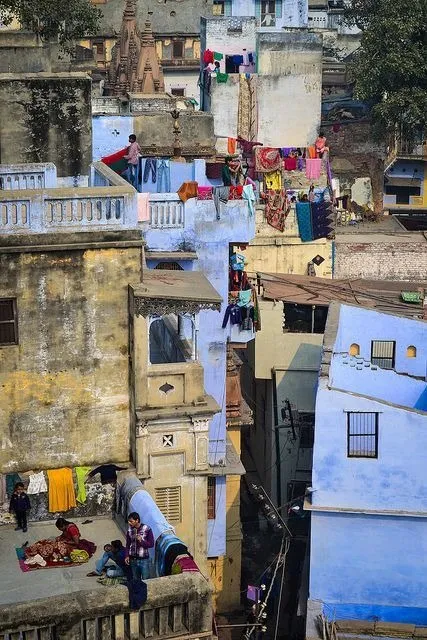
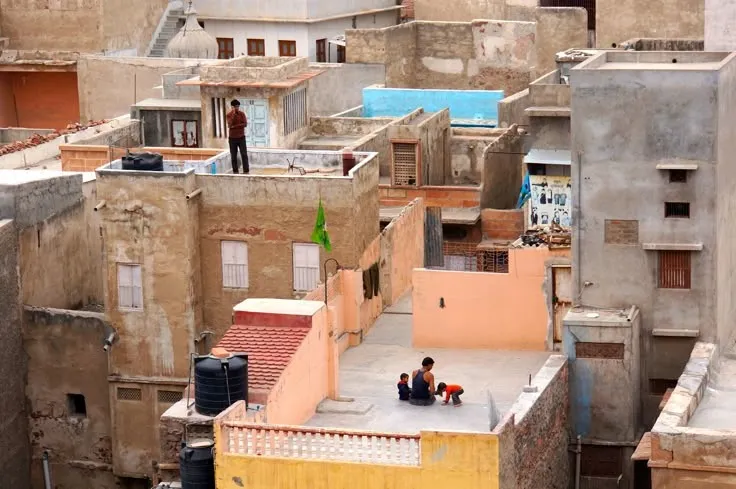
Right now being at the terrace myself, I look around I can see different lives unfolding on different rooftops. A young boy records a video. Someone eats lunch alone. A man does yoga, Another soaking the winter sun. Clothes are hung to dry. People talk, sit, wander, or simply exist. The ordinary and the intimate side by side, without colliding. Watching them grounds me. It pulls me out of my own small universe and reminds me that everyone is carrying something, everyone is living something. And even as I watch, I’m careful not to intrude. I know too well what it feels like to want to be invisible up here—to just be left alone with your thoughts.
My connection with terraces began long before I could articulate it. During the pandemic, when I was transitioning from school to college but trapped at home, the terrace became the only escape I had. I wanted to leave my house, my city, everything familiar, just to finally grow into myself. Since I couldn’t go anywhere, I went upstairs. The terrace became the only place where I could imagine who I might become. Even now, when I step onto a terrace, I’m not just looking at the sky. I’m meeting my younger self—the girl who was desperate to grow—and I realize I’m still carrying that same impulse.
Space shapes us more than we admit. Confinement shrinks us; openness allows us to expand. I learned this again when I lived alone after graduating. A roof that was entirely mine forced me to confront myself, fall apart, and rebuild with intention. Every terrace, every home, every open space I’ve lived in has held a different version of me—breaking, changing, reorganizing, growing.
And I know I speak from privilege. I’ve always had access to a terrace or a room that allowed me to breathe. That makes me wonder what happens to people who don’t. Where do they go to feel what I felt upstairs? Where do they find that small fraction of independence that a terrace naturally gives?
Terraces in India aren’t just architectural features. They are cultural necessities—silent containers for solitude, stolen privacy, emotional release, and self-preservation. It holds lives without possessing them. They witness growth without demanding proof. They offer freedom without requiring you to step outside the home.
And that’s the paradox: the space with no walls, no locks, no doors end up holding the most. It holds midnight breakdowns, teenage rebellions, stolen phone calls, afternoon naps, existential spirals, whispered confessions, silent healing. It becomes a confidant—steady, patient, and always available.
A space that lets you belong to yourself, even when the world downstairs feels too tight.That is the quiet, complicated power of a terrace.